
EV Market & the Electrical Industry: What’s Next?
According to a recent study, the push to electrify transportation is accelerating faster than many realize.
By 2030, the electric vehicle charging market will need to expand tenfold to support an estimated 27 million EVs on the road, and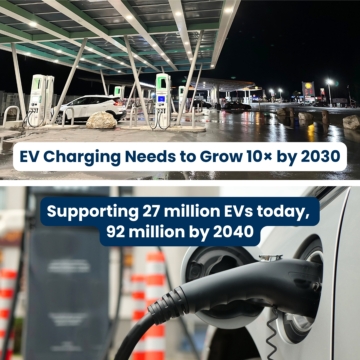 possibly 92 million by 2040. That means going from about 4 million charge points today to roughly 35 million in just seven years. Single-family and multifamily homes will make up about 80 percent of that demand.
As the EV market increases, so does the need for reliable charging across sectors. For electrical workers, this growth extends well beyond installing chargers. It includes service upgrades, load calculations, system design, maintenance, and long-term planning. Skilled electrical professionals play a critical role in all of these areas.
The EV Market: National & Regional Snapshots
Early clean-energy initiatives, utility programs, and emissions-reduction goals helped accelerate both vehicle ownership and charging deployment across Washington and Oregon. What’s changed is scale. Early EV projects often involved one or two chargers. Now, installations frequently include multi-unit residential buildings, workplace charging hubs, public parking facilities, and fast-charging sites along major routes.
EV Market Numbers: Then & Now
Just a few years ago there were nearly 2.5 million electric vehicles registered in the U.S., with a little over 64,000 charging stations.
According to data from the end of 2025, the U.S. now has 78,361 EV charging stations, supporting 237,134 individual charging ports.
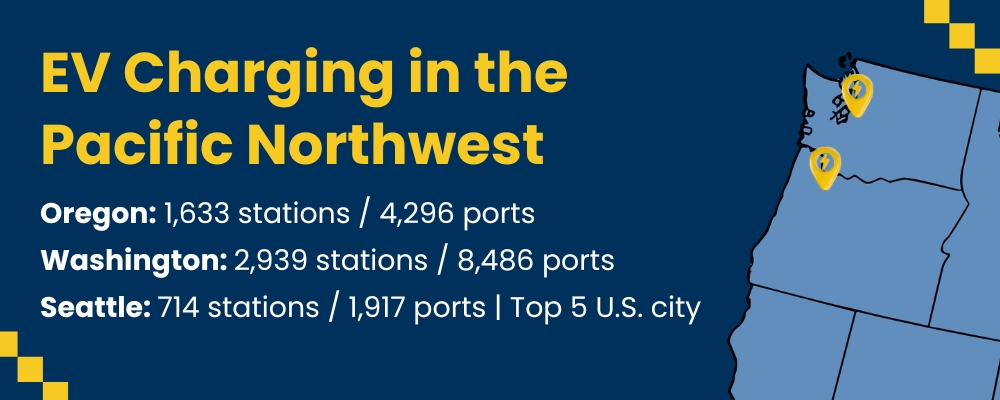
The same report shows the Pacific Northwest’s current numbers:
- Oregon: 1,633 stations and 4,296 ports
- Washington: 2,939 stations and 8,486 ports
- Seattle: Ranks in the top five U.S. cities, with 714 stations and 1,917 ports
4 Types of Charging Levels & Their Electrical Applications
Each charging level has its own specific application in both the private and public sectors, as well as its own speed and energy output. Understanding their roles in an expanding EV market is crucial for the electrical industry.
- Residential Level 2 Charging
Most single-family homes use Level 2 chargers operating on 240V service, with outputs up to approximately 9.6 kW. These systems are designed for overnight charging and often require panel capacity checks, load calculations, and code-compliant installation. - Workplace and Office Charging
Commercial Level 2 chargers are typically pedestal-mounted and hardwired. While they operate on the same voltage as residential units, shared use and longer dwell times require careful circuit planning and consideration for future expansion. - Public Parking Charging
Chargers installed in garages and public lots range from higher-power Level 2 units to DC fast chargers up to 50 kW. These installations frequently involve dedicated circuits, upgraded service, and coordination with utilities. - Highway and On-the-Go Fast Charging
DC fast chargers along highways deliver up to 150 kW and require three-phase service, robust protection, and thoughtful grid impact planning. These systems represent some of the most complex EV installations.
Electrical Contractors Are Key to Meeting EV Infrastructure Needs
As electric vehicles become more common, the demand for reliable charging infrastructure is increasing. Electrical contractors have the expertise to address the challenges this growth brings and ensure systems are safe, efficient, and ready for the future.
- Expansion of Fast-Charging Networks
Drivers expect quick, convenient charging similar to fueling stations. Meeting that expectation requires electricians experienced with high-load systems and uptime requirements. - Modernizing Aging Infrastructure
Many buildings and transit systems were not designed for EV demand. Panel upgrades, service increases, and system retrofits are becoming standard scopes of work. - Ongoing Maintenance & Repairs
Copper theft and equipment damage are driving up repair needs. Plus, many EV stations use outdated components, making replacement parts hard to find. Electricians ensure these systems stay safe and operational.
As EV charging becomes a standard fixture in homes and communities, electrical professionals with the right expertise are shaping the future of this essential infrastructure.
Keep Current with NECA-IBEW Local 48
The NECA-IBEW Local 48 partnership is a community where you can learn, share, and stay connected as the industry evolves. Membership provides access to continuing education, on-the-job training programs, and valuable support networks.
Visit our membership pages for the Oregon-Columbia Chapter of NECA or IBEW Local 48 to learn more.

